
Investors now have an opportunity to invest in Astrea VI bonds, or asset-backed fixed income securities that are backed by cash flows from private equity (“PE”) funds. Class A-1 bonds have an initial price guidance (“IPG”) of 3.25%. The IPGs for Class A-2 and Class B are 3.625% and 4.65% correspondingly.
After the Astrea VI bonds are priced, there will be three classes of bonds available for subscription – Class A-1, Class A-2 and Class B. A portion of the largest tranche (~S$250m), Class A-1, will be offered publicly to retail investors while accredited or institutional investors may invest in the Class A-1, Class A-2 or Class B tranches.
Astrea VI is the sixth transaction in a series of asset-backed securities offered by the Azalea Group. Azalea was set up to undertake the development of the Astrea Platform and launched Astrea III in 2016. The group focuses on the development, innovation and management of new investment products to broaden investor access to private equity.
About the issuer
Astrea VI Pte. Ltd. (“Astrea VI”) is a newly setup special purpose vehicle and the designated issuer of the bonds. The sponsor - Astrea Capital VI Pte. Ltd. - is the sole shareholder of the issuer and an indirect wholly-owned subsidiary of Azalea Asset Management Pte. Ltd. (“Azalea”). Azalea is owned by Seviora Holdings Pte. Ltd. and indirectly wholly-owned by Temasek Holdings (Private) Limited (“Temasek”).
AsterSix Assets I Pte. Ltd. (“AsterSix”), is the asset-owning company and a wholly-owned subsidiary of Astrea VI. AsterSix owns the limited partnership interests in the underlying PE funds, which include entitlements, rights and benefits to assets in the funds.
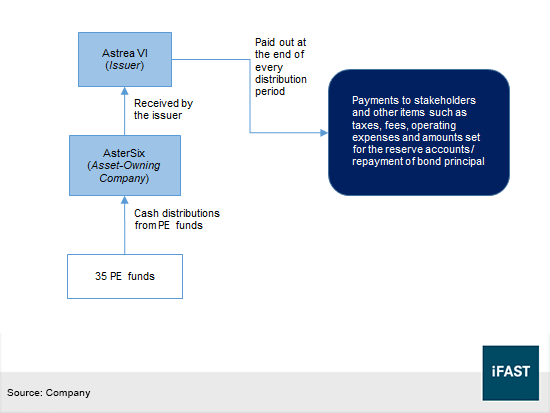
The bonds are backed by cash flows from a portfolio of 35 PE funds, which are invested in many investee companies and managed by reputable PE fund managers. At the end of every distribution period, net cash distributions from the PE funds flows through the priority of payments to meet the structural requirements of the Astrea VI bonds (Figure 1).
One tenth of the principal for the Class A bonds (herein refers collectively to the Class A-1 and Class A-2 bonds) is scheduled to be set aside every six months, meaning that there will be sufficient capital to pay down the Class A bonds in 5 years barring any significant drop in fund distributions. On this note, Astrea IV and Astrea V have received robust cash flows from their underlying PE bond portfolios. The most recent semi-annual distributions for the Astrea IV and Astrea V bonds have exceeded 10 percent of the principal for the Class A bonds.
Figure 1: An illustration of payment from the private equity funds
Diversified portfolio
The bonds are backed by a diversified portfolio of 35 private equity funds. These funds are invested in 802 investee companies as of 30 November 2020. They are managed by 28 well-known and experienced fund managers with good performance track record. Table 1 displays the list of funds for Astrea VI, which has some overlap with the Astrea V portfolio. When added together, the combined total net asset value of the portfolio (“NAV”) is USD 1,456.2m.
Table 1: List of PE funds in the portfolio at launch
|
Fund name |
NAV (USD m) |
Vintage year |
Fund name |
NAV (USD m) |
Vintage year |
|
Advent International GPE VIII-E Limited Partnership |
51.6 |
2016 |
Bridgepoint Europe V A1, L.P. |
30.0 |
2015 |
|
AEA Investors Fund VI LP |
40.4 |
2015 |
CVC Capital Partners VI (B) L.P. |
30.1 |
2014 |
|
Apollo Overseas Partners VIII, L.P. |
27.2 |
2013 |
EQT VII (No.1) Limited Partnership |
38.5 |
2015 |
|
Bain Capital Fund XI, L.P. |
55.8 |
2014 |
KKR European Fund IV L.P. |
28.6 |
2015 |
|
Blackstone Capital Partners VII L.P. |
54.0 |
2016 |
Nordic Capital VIII Alpha, L.P. |
28.2 |
2013 |
|
Carlyle Partners VI, L.P. |
40.0 |
2013 |
PAI Europe VI |
25.7 |
2014 |
|
Clayton, Dubilier & Rice Fund IX, L.P. |
32.1 |
2013 |
Permira V L.P.1 |
78.1 |
2014 |
|
KKR North America Fund XI L.P. |
51.3 |
2012 |
Bain Capital Asia Fund III, L.P. |
29.6 |
2016 |
|
Littlejohn Fund V, L.P. |
24.3 |
2014 |
CVC Capital Partners Asia Pacific IV L.P. |
28.0 |
2014 |
|
Onex Partners IV LP |
30.2 |
2014 |
Hopu USD Master Fund II, L.P. |
31.8 |
2013 |
|
Platinum Equity Capital Partners IV, L.P. |
33.1 |
2016 |
PAG Asia II L.P. |
65.1 |
2016 |
|
Providence Equity Partners VII-A L.P. |
33.4 |
2012 |
TPG Asia VI, L.P. |
30.9 |
2012 |
|
Silver Lake Partners IV, L.P. |
79.4 |
2013 |
General Atlantic, L.P. |
69.2 |
2015 |
|
TPG Partners VII, L.P. |
51.2 |
2015 |
Insight Venture Partners (Cayman) IX, L.P. |
57.8 |
2014 |
|
Vista Equity Partners Fund V-A, L.P. |
19.8 |
2014 |
Warburg Pincus Private Equity XI, L.P. |
33.8 |
2012 |
|
Vista Equity Partners Fund VI-A, L.P. |
44.4 |
2016 |
Warburg Pincus Private Equity XII, L.P. |
60.4 |
2015 |
|
A8 - B (Feeder) L.P. |
40.5 |
2012 |
Yunfeng Fund II, L.P. |
51.3 |
2014 |
|
Bain Capital Europe Fund IV, L.P. |
30.4 |
2015 |
|||
| Source: Company, iFAST compilations | |||||
Underlying PE funds are mature and seasoned
As seen by their vintage years, most of the funds in the portfolio are made up of mature and seasoned private equity investor interests. In fact, the weighted average age of the funds is 5.8 years. Acquiring a limited partner’s interest at a later stage in a PE fund’s life allows the investor to possibly avoid the negative cash flows in the initial years of a typical PE fund. Furthermore, investors in mature PE funds have more visibility into the asset base, and may benefit from a shorter investment duration and receive an accelerated return on capital.
In other words, the Astrea VI portfolio is a secondary fund of PE funds (“FoF”), which are portfolios that invest in PE funds through the secondary market. Primary FoFs on the other hand, invest in PE funds at their inception.
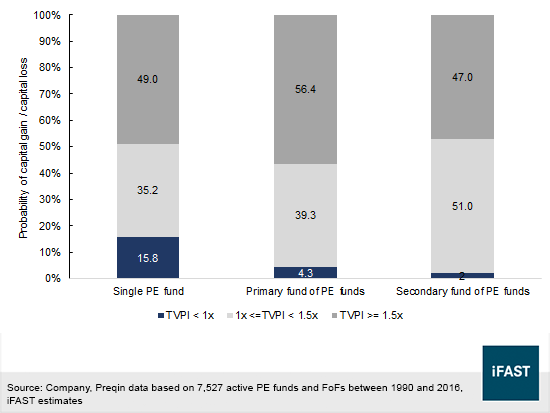
According to Preqin (a private equity data provider) and results shown in the bond prospectus, investing in FoFs would have provided investors better downside protection than investing in a single PE fund between 1990 and 2016.
The data also showed that investing in a random PE fund would result in a loss of capital 15.8% of the time (which occurs when the TVPI, or total value to paid-in multiples is less than 1x) while the likelihood of loss for a secondary FoF is around 2.0% (Figure 2). In addition, the largest historical loss experienced by a single secondary FoF between 1990 and 2016 was only approximately 17%.
Figure 2: Probability of capital gain and loss by fund type between 1990 and 2016
Further information on the Astrea VI PE bonds
According to the preliminary bond prospectus dated 25 Feb 21, the public offer period is targeted to be between 10 Mar 21 and 16 Mar 21.
Three classes of Astrea VI bonds will be issued with maturities in March 2031. Class A bonds are scheduled to be called in March 2026 depending on the satisfaction of certain conditions (see Table 2). If the Class A bonds are not redeemed at their scheduled call date, the coupon rate on the bonds will be stepped up one-time by 1% p.a. so as to compensate investors for the extended tenor. Holders of the Class A bonds will continue to receive interest payments until sufficient funds are accumulated to redeem the bonds in full.
The expected credit ratings for Class A-1 bonds are A+sf by Fitch Ratings and A+ (sf) by S&P. Meanwhile, Class A-2 bonds and Class B bonds are projected to be rated Asf and BBBsf respectively by Fitch Ratings. These expected new bond ratings are close to the ratings for the other Astrea bonds. Recently on 22 Feb 21, Fitch Ratings upgraded their ratings for the Astrea III Class B bonds to A+sf. Fitch also upgraded the Astrea IV Class A-2 bonds and Astrea V Class A-1 bonds to A+sf.
The Astrea VI transaction is a type of structured finance instrument. Class A-2 and Class B securities are categorized as Specified Investment Products (“SIP”). Additionally, Class A-2 and Class B bonds are not available to retail investors for subscription.
To protect investors, the Monetary Authority of Singapore has imposed regulations to require all financial institutions to assess investors for relevant knowledge or experience in trading SIPs. To invest in a listed SIP like the Class A-2 and Class-B bonds, individuals with the exception of accredited investors have to “pass” or fulfil the Customer Account Review (CAR) criteria.
Table 2: Astrea VI PE bond summary
|
Class A-1 |
Class A-2 |
Class B |
|
|
Scheduled call date |
March 2026 |
March 2026 |
N.A. |
|
Maturity month |
March 2031 |
March 2031 |
March 2031 |
|
Bond currency |
SGD |
USD |
USD |
|
Denominations |
SGD 1,000 |
USD 50,000 |
USD 200,000 |
|
Available to retail investors? |
Yes |
No |
No |
|
Expected issue price |
100% |
100% |
100% |
|
One-time coupon step-up if not redeemed on the scheduled call date |
1% per annum |
1% per annum |
N.A. |
|
Callable if |
On the scheduled call date, and any subsequent distribution period after the scheduled call date date, provided (i) the amount in the reserves accounts and custody account is adequate to cover the Class A-1 bond principal and (ii) no Credit Facility loan is left outstanding |
On the scheduled call date, and any subsequent distribution period after the scheduled call date, provided (i) the amount in the reserves accounts and custody account is adequate to cover the principals of Class A-1 and Class A-2 bonds and (ii) no Credit Facility loan is left outstanding |
N.A. |
|
Mandatory partial redemption of bond principal |
N.A. |
Applicable once the Class A-1 bonds have been fully redeemed. |
Applicable once the Class A-1 and Class A-2 bonds have been fully redeemed. A 90% cash flow sweep after application of clause 1 through clause 8 of the priority of payments will be applied to decide the amount of partial redemption |
|
Bonus redemption premium |
Up to 0.5% of the principal amount depending on the balance in the Bonus Redemption Premium reserves account at the applicable redemption date |
N.A. |
N.A |
|
Clean-up option |
N.A. |
N.A. |
Optional once the Class A-1 and Class A-2 bonds have been fully redeemed, and less than USD 50m of the principal remains outstanding |
|
Traded on the Singapore Exchange? |
Yes |
No. traded in the secondary bond market |
No. traded in the secondary bond market |
|
Expected credit rating |
A+sf by Fitch Ratings, and A+ (sf) by S&P |
Asf by Fitch Ratings |
BBBsf by Fitch Ratings |
| Source: Company | |||
Class A-1 is ranked pari passu with Class A-2 in the Astrea VI structure, although there are differences in the sequence of payments when the amounts in the reserves accounts are used to pay down bond principals. Collectively, the Class A notes form the most senior class of bonds. This means that in the event of a liquidation, Class-A bondholders have a higher priority to the claims of the assets over Class B bondholders and equity holders. In addition, repayment of the Class B notes begin after Class A bonds are paid off using 90% of the remaining distributions after applying clauses 1 to 8 of the priority of payment waterfall.
According to the debenture documents, creditors are secured by (i) a first fixed charge by the issuer over shares in the asset-owning company, as well as present and future dividends from these shares; (ii) a first fixed charge by the issuer over bank and custody accounts; (iii) an assignment of the issuer’s rights under the shareholder loan agreement; and (iv) a first floating charge by the issuer of their respective undertakings, together with present and future assets.
In the remote event of a bond default, the priority of payment to stakeholders will be modified. Any remaining liquidity will first be paid for (1) taxes and operating expenses, followed by (2) amounts due to hedge counterparties, (3) outstanding fees related to the Credit Facility including the repayment of any facility loan, (4) unpaid accrued interest on the Class A-1 and Class A-2 bonds on a pari passu and pro-rata basis, (5) outstanding principal amount of the Class A-1 and Class A-2 bonds on a pari passu and pro-rata basis, followed by (6) unpaid accrued interest on the Class B bonds, (7) outstanding Class B bond principal amounts, (8) other expenses, (9) capital calls, (10) hedge counterparties for the early termination of swap transactions if applicable and (11) payment to the sponsor.
Pricing views
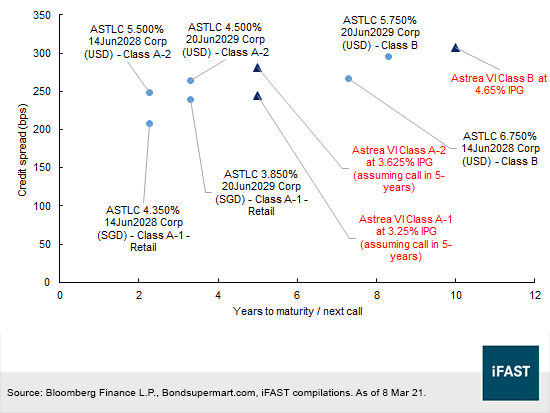
We think that the new Astrea VI notes are attractively priced. For example, the Class A-1 notes have an IPG of 3.25%, representing a pickup of 44 basis points (“bps”) from the ASTLC 3.850% 20Jun2029 Corp (SGD) - Class A-1 – Retail and 80bps from the ASTLC 4.350% 14Jun2028 Corp (SGD) - Class A-1 - Retail, which have indicative yields to worst (“YTW”) of 2.81% and 2.45% on 8 Mar 21 (Figure 3). The IPG for the Class A-1 bond is attractive at a credit spread (“G-spread”) of 245bps assuming a 5-year call.
Figure 3: Relative valuation using YTWs
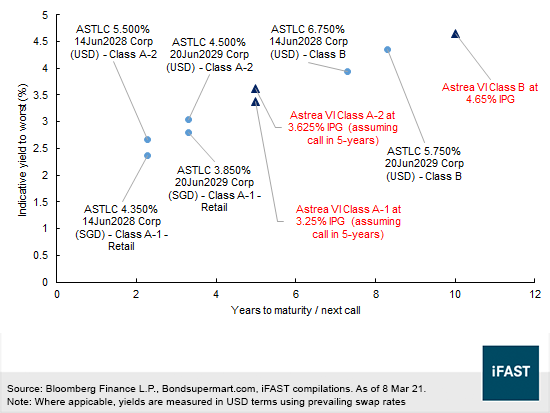
Class A-2 bonds have an IPG of 3.625%, and this is 58bps higher than the ASTLC 4.500% 20Jun2029 Corp (USD) - Class A-2 (YTW: 3.05%) and 95bps higher than the ASTLC 5.500% 14Jun2028 Corp (USD) - Class A-2 (YTW: 2.68%). If the bonds are redeemed on their 5-year scheduled call date, the G-spread for the Astrea VI Class A-2 bonds would be 281bps, measured as the difference between the IPG of 3.625% and the 5-year US Treasury yield of 0.81% on 8 Mar 21. Respective G-spreads for the ASTLC 4.500% 20Jun2029 Corp (USD) - Class A-2 and ASTLC 5.500% 14Jun2028 Corp (USD) - Class A-2 are 265bps and 248bps respectively.
In the meantime, investors who have a preference for higher yields may consider the new Class B notes at its IPG of 4.65%, which is providing a 29bps premium over the ASTLC 5.750% 20Jun2029 Corp (USD) - Class B (YTW: 4.36%) and a 70bps pickup over the ASTLC 6.750% 14Jun2028 Corp (USD) - Class B (YTW: 3.95%). The 29bps premium for a 2-year difference may not be that appealing given that the two portfolios –Astrea VI and Astrea V have similar fund compositions but we think that the IPG for the Class B bond still offers an attractive yield pick-up of 307bps over equivalent 10-year US Treasuries.
Figure 4: Relative valuation using G-spreads
In part two of our Astrea VI article – “Astrea VI: the most anticipated PE bond offering for 2021 has been announced (Part 2)” - we share more on the portfolio’s composition, investment risks and structural safeguards.
Declaration: For specific disclosure, at the time of publication of this report, IFPL (via its connected and associated entities) and the analyst who produced this report hold a NIL position in the abovementioned securities.
Our podcast series, Yield Hunters, is available on Spotify, iTunes Podcasts and Google Podcasts.
In a time when bonds were (and still are) typically made available to institutional investors and HNW investors, Azalea Investment Management made headlines when they issued Astrea IV, the first ever Private Equity bond accessible to retail investors in Singapore.
In this episode, we speak with Lim Jun Jie, Associate Director at Azalea Investment Management to find out more about the Astrea bonds, how such private equity bonds work and how they can add value to our investment portfolios. Tune in below and follow us!